How to Understand and Apply the AI-DLC Development Methodology?
- 12 Jun, 2026
When using AI development tools like Claude Code, Trae, or Cursor, many developers often fall into the trap of casual coding (so-called Vibe Coding): whatever comes to mind, write a simple prompt and let the AI write the code. While this approach is highly efficient for writing simple applications or script files, it quickly leads to codebase clutter, loss of context, and exorbitant maintenance costs when facing more complex, medium-to-large-scale projects. To address these challenges, AWS proposed and open-sourced a core methodology in early 2025: AI-DLC (AI-Driven Development Life Cycle).
The Concept of AI-DLC
In traditional software development workflows, the overall framework of the development process is primarily driven by humans. Product owners, developers, and architects spend a significant portion of their time on non-core activities such as planning, meetings, and other aspects of the SDLC (Software Development Life Cycle).
With the rise of Generative AI technology, the technology and quality of AGI tools in understanding semantics, reading, and writing code have advanced by leaps and bounds. However, if AI is merely treated as a localized development tool to assist with auto-completion and code generation, it fails to unleash its powerful semantic understanding and generative capabilities. Furthermore, it easily falls into a localized dilemma, unable to meet the development demands of medium-to-large-scale projects.
In response, AWS proposed a methodology to reconstruct the entire software development process and responsibilities for the AI era: AI-DLC. The core idea of this methodology is: In the software development lifecycle, redefine the cooperative relationship between humans and AI, where humans codify the judgment and make decisions, and AI orchestrates, executes, and self-verifies (Humans codify the judgement. AI orchestrates and self-verifies).
You can intuitively understand the paradigm shift of software development workflows in the AI era through the comparison table below:
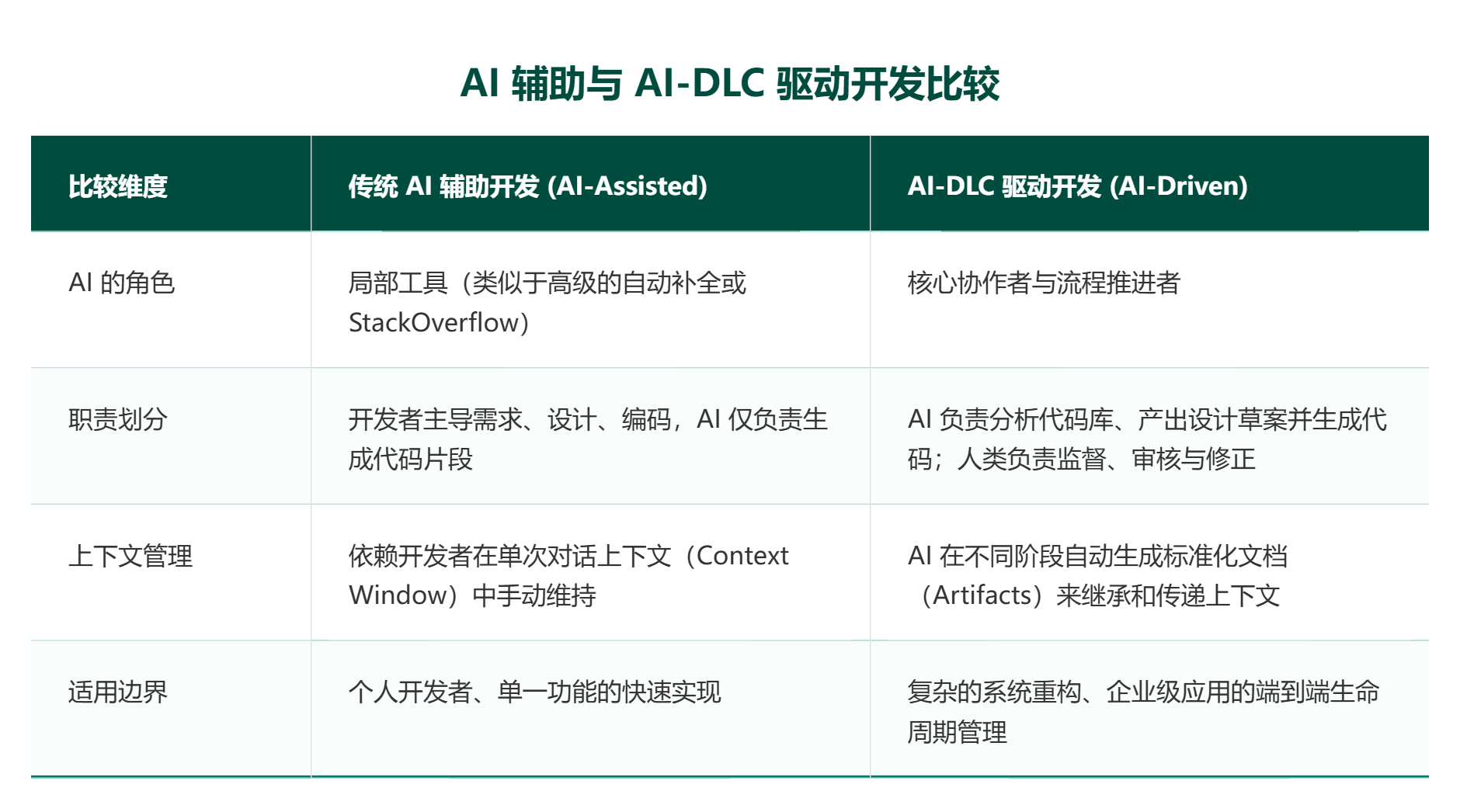
The overall logic of AI-DLC can be understood from the following two dimensions:
- AI-driven execution workflow under human supervision: For specific development requirements, the AI systematically creates detailed work plans and processes, actively seeks clarification and guidance during collaboration with humans, and leaves critical decision-making steps to human judgment. This is crucial because only humans possess the contextual understanding and business requirement knowledge needed to make informed choices. AI tools must operate within a framework guided and judged by humans rather than acting arbitrarily. Once requirements are clarified and the execution plan is confirmed, the subsequent execution process is entirely completed by AI tools, with humans providing side supervision.
- Dynamic teamwork: During the execution of tasks based on established plans, the team consisting of humans and AI unites within a collaborative space to solve problems in real-time, engage in creative thinking, and make rapid decisions. This shift from isolated work to high-energy teamwork accelerates innovation and delivery.
The Workflow of AI-DLC
Overall, the AI-DLC development philosophy operates according to the following workflow: The AI is responsible for formulating a work plan based on project requirements. During the planning process, it raises clear questions regarding ambiguities in requirements and technical solutions to seek further context and background information. The final technical execution plan and action plan are then implemented and executed after receiving human validation.
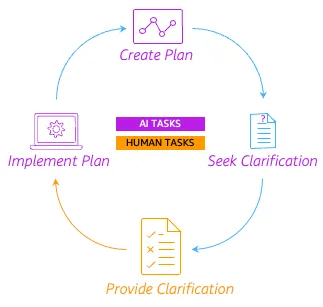
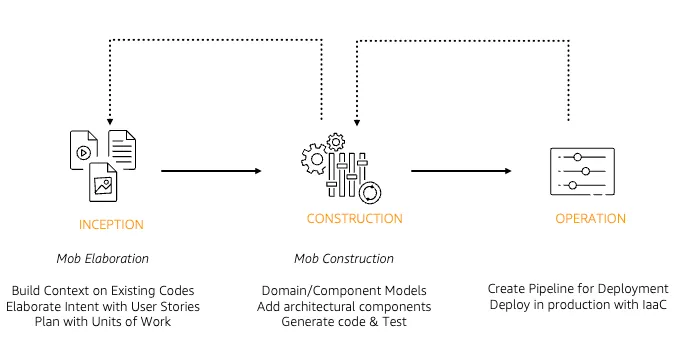
Following the overall philosophy and workflow outlined above, AI-DLC does not let AI start writing code immediately after receiving requirements; instead, it forces AI Agents to follow a rigorous engineering stages framework. It divides the development process into the following three core phases.
Phase 1: Inception
This phase is responsible for clarifying requirements, formulating plans, and defining execution steps—addressing the questions of “what to build” and “why build it.”
Tasks to be performed in this phase include:
- Workspace Detection & Reverse Engineering: The AI first scans the existing codebase to understand the current architecture, technology stack, and existing business logic code.
- Requirements Analysis & User Stories: The AI clarifies ambiguous requirements by asking questions and receiving clear answers, breaking them down into standard User Stories.
- Application Design & Workflow Planning: After determining the overall system design architecture, the AI is responsible for breaking down large tasks into independent “Units” that can be executed in parallel or sequentially.
Phase 2: Construction
In this phase, the AI begins processing the Units one by one according to the plan established in the Inception phase. For each unit, the AI cyclically executes the following steps:
- Detailed Design: Includes functional design (code logic), non-functional design (security and performance considerations), and infrastructure design.
- Code Generation & Test-Driven Development: AI-DLC strongly mandates that code and test cases must be generated synchronously. Adopting a test-driven development model can effectively enhance development quality control.
- Self-Building & Verification: The AI attempts to run the build and execute test cases by itself. If errors occur, it self-heals based on the error logs.
Phase 3: Operations
This step involves post-development deployment, operations, monitoring, and maintenance. It primarily includes code deployment, continuous integration, and post-launch monitoring. The AI similarly assists in troubleshooting logs, generating operations reports, and performing continuous optimization within this workflow.
In fact, each of the above phases provides richer background and context for the execution of the next phase, enabling the AI to provide increasingly wise suggestions and execution outcomes.
Comparison Between the AI-DLC Philosophy and Latest AI Development Tools
Based on studying the AWS AI-DLC development philosophy whitepaper and its related technical documents, the theoretical knowledge related to this development process and philosophy has been organized above.
However, looking back from today’s perspective (June 2026), you will find that the concept of AI-DLC is actually nothing extraordinary. This is because most mainstream AI development tools we use today (such as Antigravity 2.0, Claude Code, Codex, etc.) have naturally embedded and enforced the core development workflows and rules described above within their underlying architecture designs.
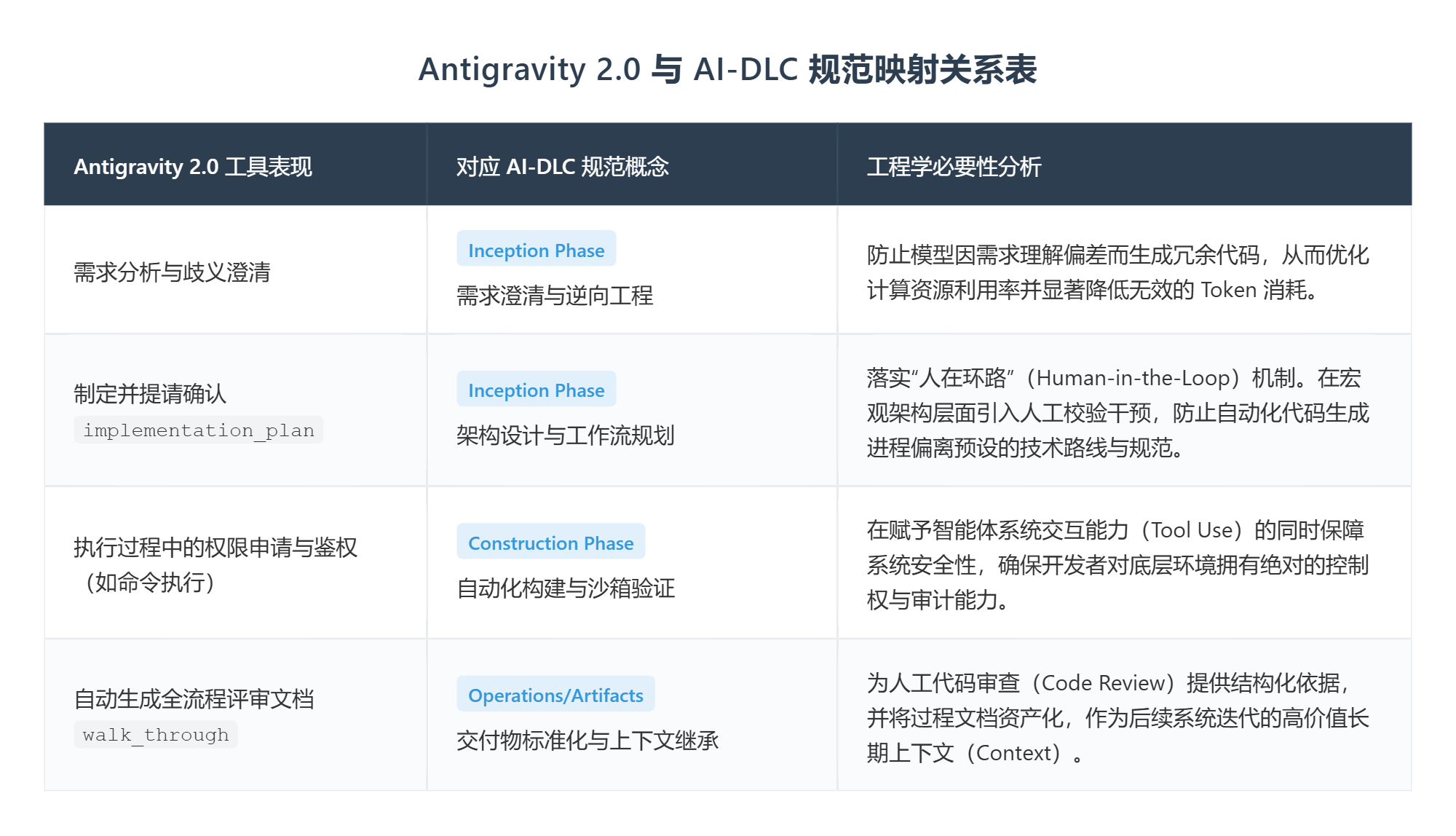
For example, when using Google’s Antigravity 2.0 for software development, if I propose a development requirement in a project, Antigravity 2.0 will first analyze my requirement before modifying any code, raise questions to confirm any ambiguities, and generate an implementation plan document. Once I confirm this execution plan, Antigravity 2.0 begins execution, requesting permissions and confirming intermediate steps when necessary during the execution process, and finally summarizes the complete execution process through a walk-through document after development is completed. Therefore, this automated process already perfectly covers the AI-DLC development philosophy—and this is merely an out-of-the-box feature of tools like Antigravity.
However, back in March 2025, when mainstream AI development tools were still unable to handle medium-to-large-scale project development, the proposal of AI-DLC still held significant value and application prospects. The breakthroughs in the capabilities of AI software development tools to handle medium-to-large-scale projects in the second half of 2025 happened because the entire AI software engineering community, having learned lessons from 2023–2024 regarding unorganized prompts and blind coding leading to context collapse, collectively converged on using more standardized, process-oriented approaches to improve AI code quality.
Below is a mapping and comparison between the AI-DLC development philosophy and current Antigravity 2.0 implementations:
The Value of the AI-DLC Philosophy
Looking at it today in 2026, as AI development tools have become increasingly advanced and standardized, does AI-DLC and its associated development rules and workflows still hold value?
I believe that regardless of how development tools evolve, such development rules still deserve attention in at least the following two aspects.
Unified Team Development Rules and Standards
In team development, different developers have their own preferences for development tools—some are used to Trae, some use Claude Code, and others stick to Cursor. Differences in the underlying behaviors of various tools can lead to uneven quality in team-developed code.
Therefore, we can define explicit rules common within the team, such as aidlc-workflows (like .cursorrules or global system prompts), to standardize AI behavior across tools within the team. No matter what tool a developer uses, as long as this unified set of development rules (Rules) is loaded, the AI will be forced to write design documents and unit tests first, thereby achieving standardization in engineering quality.

Rules Can Handle More Complex Multi-Agent Collaborative Scenarios
Even today, development tools like Antigravity 2.0 still lean towards scenarios where a single powerful Agent solves a specific issue. However, when we face ultra-large-scale project development and refactoring, we often need Product Agents, Architecture Agents, Coding Agents, and Testing Agents to work collaboratively. The Adaptive Workflow Steering proposed by AWS is essentially a theoretical framework built for future Multi-Agent Orchestration, where different Agents correspond to their own Rules, aligning their workflows more closely with the requirements of their role definitions, thereby enhancing the development quality of each individual Agent.