Analog HD Video Transmission Technology
- 14 May, 2020
Background
Having worked in the camera industry, my focus has always been on digital, or IP, cameras. Consequently, my understanding of analog cameras was stuck in the past, based on knowledge from over a decade ago: CCD standard-definition modules, CVBS interfaces, coaxial cable transmission, and the perception that analog cameras could not support high-definition resolutions.
- Regarding analog image transmission solutions supporting high definition, my impression was limited to Dahua’s previously introduced HD-SDI solution, which was reportedly capable of supporting 1280x960 resolution at the time.
It wasn’t until a recent new in-vehicle DVR project at my company that I realized analog cameras have long been capable of supporting high-definition resolutions, even transmitting 4K analog video images. Therefore, in this article, I will study and organize the popular analog HD image transmission solutions currently available on the market to fill this knowledge gap.
Advantages of Analog HD Video Transmission Technology
The most mature analog video transmission solution has probably been the use of CVBS interfaces combined with coaxial cables to transmit standard-definition analog video. This was also the standard transmission method used by most analog cameras previously.
CVBS: Composite Video Blanking and Sync.
- Typically uses BNC or RCA connectors.
- Can support analog video transmission up to 960H resolution, i.e., 960x576 (PAL) or 960x480 (NTSC).
- Uses an interlaced scanning method, primarily adapted for early CRT monitors.
Therefore, traditional CVBS methods cannot support the transmission of so-called high-definition image and video signals at 720P or higher resolutions. The problem that various analog HD video transmission technologies aim to solve can all be summarized as: how to use a single coaxial cable to transmit analog high-definition video signals.
The advantages of such technology compared to digital/IP image transmission technology are:
- Extremely convenient deployment and installation (no complex networking or setup required; simply connect a single cable for immediate use).
- Can easily replace existing analog surveillance lines/systems, meaning high-definition analog video signals can be transmitted using the same coaxial cables as traditional standard-definition analog cameras. This significantly reduces the cost for users to upgrade their existing SD equipment.
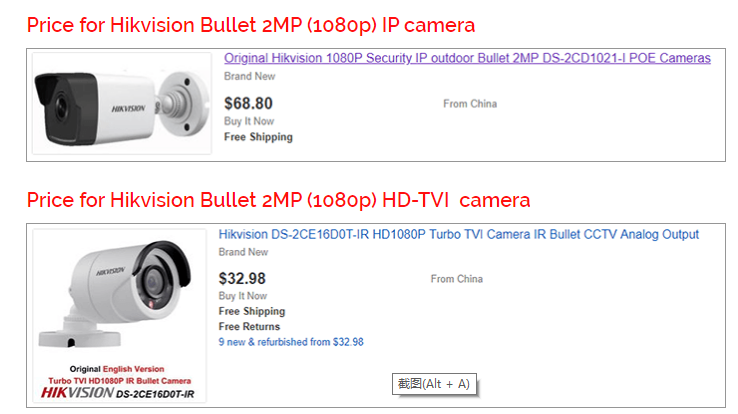
- From the current perspective, analog HD cameras of roughly similar specifications are still significantly cheaper than network cameras:
AHD: Analog High Definition.
Developed by the Korean manufacturer NextChip, which primarily produces AHD technology chips for downstream manufacturers of analog HD cameras and DVR products.
Utilizes coaxial cable for video transmission, supporting up to 720P and 1080P.
AHD1.0 can support up to 720P; AHD2.0 can support 1080P video transmission over RG59 coaxial cable up to a distance of 500m.
Camera-side TX chips: NVP2430H/NVP2431H; DVR-side RX chips: NVP6114/NVP6124B.
HD-TVI: High Definition Transport Video Interface.
Developed by a Japanese company, TechPoint, and first launched in 2014.
This solution is the most popular analog HD transmission scheme in the U.S. market, supported by many major manufacturers. For instance, Hikvision has launched multiple models of analog HD cameras using TechPoint’s chips.
The original goal was to support real-time transmission of analog video signals over coaxial cable for distances up to 500m.
In 2016, Hikvision claimed that using the HDTVI 3.0 protocol, it could support 720p video transmission up to 1200m and 1080p video transmission up to 800m.
The latest version now supports the transmission of 4K, or 8-megapixel, analog video.
HD-CVI: High Definition Composite Video Interface.
This technology was introduced by Dahua in 2012 and is widely used in China.
In addition to manufacturing analog cameras using this technology themselves, Dahua also licenses it to other companies.
The working mechanism of this solution is similar to HD-TVI, but it employs different digitization strategies for signal transmission.
Initial versions could transmit two HD video formats, 1080P and 720P, over coaxial cable. As of now, with the release of HD-CVI 3.0, it can also support the transmission of 4K, or 8-megapixel, analog video.
HD-SDI: High Definition Serial Digital Interface.
Can support up to 1080P.
A closed standard, patented technology by Chinese manufacturer Dahua.
SDI is actually a digital video technology that uses coaxial cables to transmit serial digital video signals. Therefore, before transmission, analog video signals need to be digitized and serialized before being sent over coaxial cable, making it difficult to truly classify it as an analog video transmission solution.
It has high requirements for the transmission medium, is not suitable for long-distance transmission, and has largely faded from the market.
Summary
- AHD, HD-TVI, and HD-CVI all support transmitting analog HD video signals in HD or even 4K formats over traditional coaxial cables. However, this requires dedicated TX chips at the image sending end (typically the camera) for custom encoding of the signals, and dedicated RX chips at the image receiving end (typically the DVR) for custom decoding of the signals.
- The three technologies mentioned above are largely similar in their working principles and specifications, but each has its own strengths in market promotion: HD-TVI holds an absolute advantage in the US; HD-CVI is better promoted in China and has become a national standard; AHD is mainly used in the Japanese and Korean markets, but has rapidly opened up its market with its low-cost advantage.